Special requirements for pet treat packaging pouches
Pet treat packaging pouchesDirectly contacting food, pet treat pouches must comply with food contact material safety standards. In 2025, China’s pet treat market reached CNY 58 billion, up 18.5% year on year, while demand for pet treat pouches grew 22% in tandem.
| Standard | Scope | Core requirements |
|---|---|---|
| GB 4806.1-2016 | Pet food for the Chinese market | Sensory indicators, physical/chemical indicators, additive use |
| FDA 21 CFR | Pet food exported to the US | Food contact substance list |
| EU 10/2011 | Pet food exported to the EU | Overall migration limits |
Key note: pet food pouches must carry thefood contact mark and provide third-party test reports. Refer to theState Administration for Market Regulation food-contact material standards for the latest requirements.
Barrier performance requirements for pet treat packaging pouches
Pet treats (especially meat-based treats) are sensitive to oxygen, moisture and light, and require high-barrier packaging.
| Snack type | Oxygen transmission rate requirement | Recommended material structure |
|---|---|---|
| Dried meat treats | <5 cm³/m²·24h | PET/AL/PE |
| Freeze-dried treats | <1 cm³/m²·24h | PET/AL/PA/PE |
| Biscuit-type treats | <10 cm³/m²·24h | PET/PE、BOPP/CPP |
| Wet food (moisture-containing) | <2 cm³/m²·24h | PET/AL/PA/PE |
Material selection: a full comparison of PET/PE, aluminum foil and mono-materials
Mainstream material structures for pet treat packaging pouches
1. PET/PE structure — high transparency, moderate cost, good print results; average barrier; suitable for biscuits and low-oil treats; cost index ⭐⭐
2. PET/AL/PE structure (with aluminum foil) — excellent barrier and long shelf life; opaque, non-recyclable, high cost; suitable for meat treats and freeze-dried treats; cost index ⭐⭐⭐⭐
3. PET/PA/PE structure (with nylon) — puncture-resistant, good barrier, transparent; higher cost; suitable for bone-in treats and sharp-shaped treats; cost index ⭐⭐⭐
4. Mono-material PE structure — recyclable, eco-friendly, compliant with the EU PPWR regulation; average barrier, requires coating; suitable for pet food exported to the EU; cost index ⭐⭐⭐
For a detailed comparison of different materials, refer to our earlierPros and cons comparison of 6 common packaging materials。
Pouch type selection: how to choose between stand-up pouches, 8-side seal pouches and shaped pouches?
Pouch type decision framework for pet treat packaging
| Pouch type | Applicable products | Shelf effect | Cost | Recommended scenario |
|---|---|---|---|---|
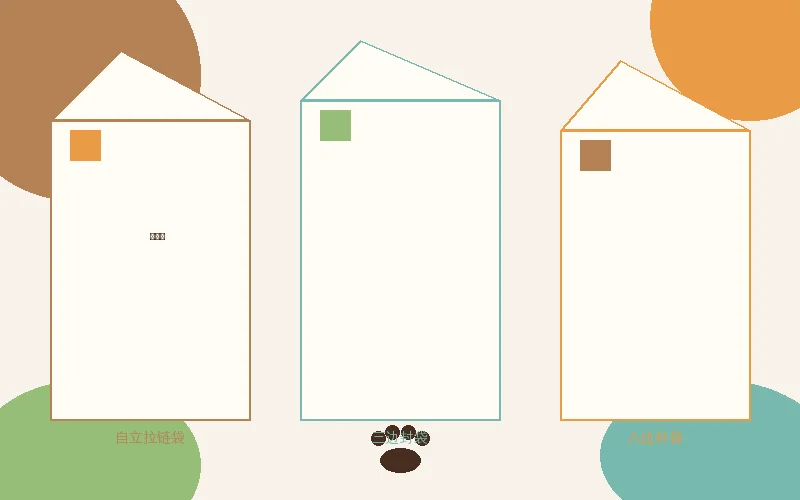
| stand-up zipper pouch | 50g-500g treats | ⭐⭐⭐⭐ | ⭐⭐⭐ | Mainstream choice |
| 8-side seal pouch | 500g-2kg treats | ⭐⭐⭐⭐⭐ | ⭐⭐⭐⭐ | Premium positioning |
| three-side seal pouch | 10g-50g small packs | ⭐⭐ | ⭐ | Trial packs, gifts |
| shaped pouch | Pet treat gift boxes | ⭐⭐⭐⭐ | ⭐⭐⭐⭐ | Differentiated competition |
Stand-up zipper pouches arePet treat packaging pouches the most mainstream pouch type, for three reasons: standing display, repeated opening and flexible capacity. Practical experience: individual pet treat packs (10g-30g) use three-side seal pouches, family packs (200g-500g) use stand-up zipper pouches, and gift packs (1kg and above) use 8-side seal pouches.
Printing process: choosing between composite printing and digital printing
1. Lamination printing (gravure printing): saturated colors, consistent batch quality, low cost (large volumes); high plate-making fees and high minimum order quantities; suitable for stable bulk orders (>10,000 pcs).
2. Digital printing: no plate fees, viable for small batches, fast delivery (3-7 days); higher unit price, slightly less consistent color; suitable for new product testing, small batches and personalization.
Selection of printing inks: water-based inks are eco-friendly with low VOC and recommended; UV inks are vivid but have high VOC emissions;benzene-free and ketone-free inks is mandatory for food packaging and complies withEU food contact materials framework regulation (EC) No 1935/2004 standard.
Compliance essentials: special requirements for pet food packaging
Labeling requirements for pet treat packaging pouches
| Label element | Requirement | Basis |
|---|---|---|
| Ingredient list | Must be labeled | GB 7708-2011 |
| Net content | Must be labeled | Metrology Law |
| Production date / shelf life | Must be labeled | Food Safety Law |
| Storage conditions | Recommended | Industry practice |
| Food production license number | Must be labeled | SC certification requirements |
| Pet food labeling | Must be labeled | GB/T 31217-2014 |
Packaging compliance for exported pet food
| Target market | Compliance requirements | Packaging impact |
|---|---|---|
| US | FDA registration, ASTM standards | FDA compliance statement required |
| EU | FEDIAF standards, PPWR regulation | Prefer recyclable materials |
| Japan | Pet Food Safety and Hygiene Law | Local Japanese test reports required |
Cost control: 5 ways to reduce pet treat packaging costs
1. Lightweight design: thinner pouch walls cut material costs by 10%-20%
2. Standard sizes: use supplier standard tooling to waive mold fees
3. Bulk purchasing: annual usage above>50 tons, lock in pricing
4. Mono-materials: meets EPR requirements, reducing fees by 30%-50%
5. Localized supply chain: reducing shipping costs and lead times
Summary: selection framework for pet treat packaging pouches
Looking back atPet treat packaging pouches as a whole, selection can be summarized as:
- Determine product characteristics -> meats/biscuits/freeze-dried, oil content, moisture content
- Determine materials -> PET/PE, PET/AL/PE, PET/PA/PE, based on barrier requirements
- Determine pouch type -> stand-up zipper pouches (mainstream), 8-side seal pouches (premium)
- Determine printing -> gravure (large volumes), digital (small batches)
- Determine compliance → food-contact material standards, labeling requirements, export compliance
Pet treat pouches are not about “the more expensive the better”, but “the safer and more suitable the better”.
To learn more about choosing between pouch types, see ourDetailed Guide to Common Flexible Packaging Pouch Types。
ForPet treat packaging pouches have customization needs? Welcome toContact OMOPACK. We offer one-stop service from material selection, structural design, printing and sampling to mass production, with our professional team providing free customization advice to help your product stand out on the shelf.
—
References:State Administration for Market Regulation food contact material standards, EU framework regulation on food contact materials、FEDIAF《Pet Food Packaging Guidelines 2025》